Every human being is a work of art that inexorably strives toward its completion
The human being and art
Joseph Beuys on the expanded concept of art
The expanded concept of art is the overarching intellectual reference of this project. It liberates art from the object and returns it to process, to society, to every single person. Art is not the painting on the wall. Art is the moment a person begins to consciously shape their surroundings. A conversation can be art. Working the soil can be art. The way a community relates to one another can be art. Beuys called this social sculpture: society as malleable material, shaped through creativity. Barranco Spirit is the ground on which art takes place. It is itself part of the work. Light, animals, plants, winds, seasons, everything participates. Every person who comes, co-creates. The creativity of the individual, as a singular outlet of the universal whole, is the highest creative expression. What Beuys described is timeless. It is individually and universally applicable.
Olafur Eliasson on sustainable futures
Eliasson places the transformation in the hands of the viewer. The artist steps behind the work. What counts is not the intention, but what happens inside the person who encounters the work. His pieces make natural phenomena tangible. Light, colour, fog, temperature are brought into a space in such a way that one's own perception becomes visible. For Eliasson, perception is not a private act. It is a social, ecological and political process. He invites people to enter spaces for action. Spaces that are not looked at, but lived. In the Barranco, this happens on terraces of stone and earth, in the wilderness between plants and animals, beneath cork oaks, in the silence of a valley that has no intention. Eliasson's work does not end at individual perception. With Future Assembly, a project for the Biennale di Venezia 2021, his Studio Other Spaces posed the question of what an assembly might look like that does not represent humans alone. Fifty living and non-living participants, fungi, river stones, tree trunks, bats, gathered on a world map made from recycled ocean plastic. The rights of trees, minerals, rivers were negotiated as those of nations. The thought behind it is radically simple: we are not the only ones, and it is not only about us.
Christoph Lukas & Petra Lorber on the philosophy of Barranco Spirit
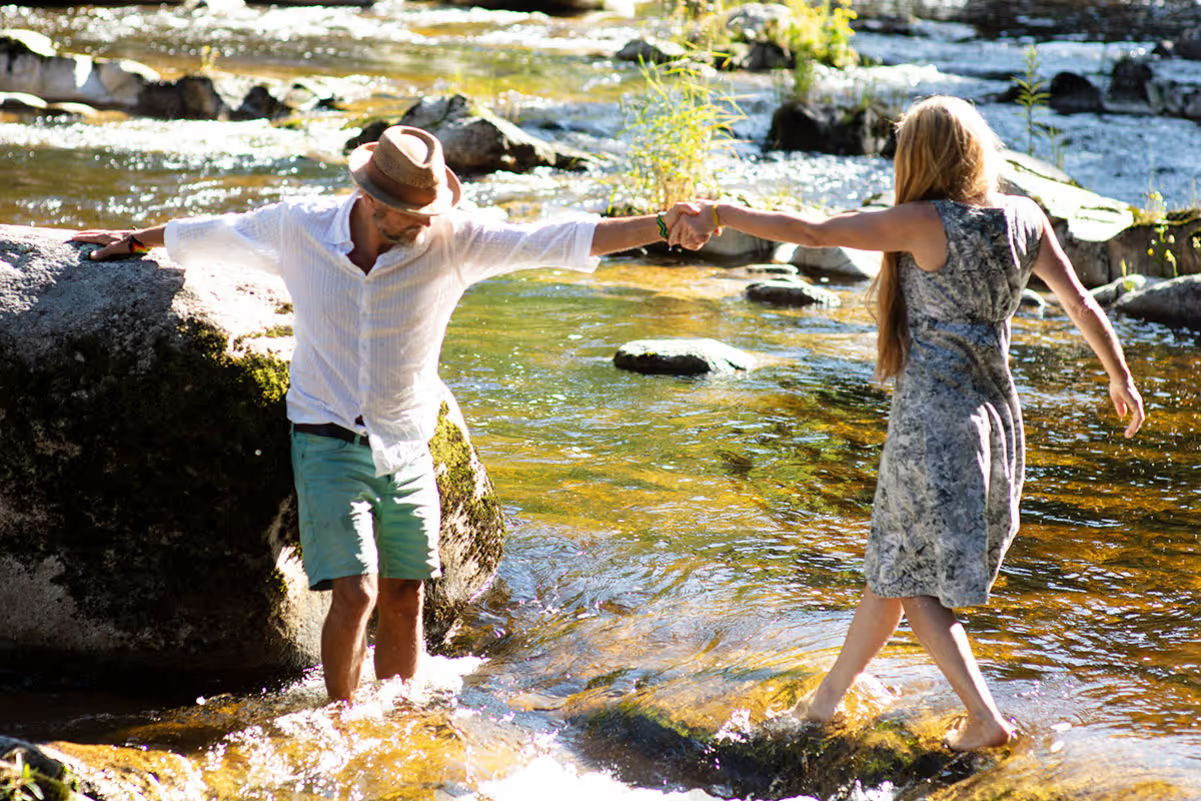
We live in a time in which the experience of separation grows ever stronger. Between people, between people and nature, between us and our own core. Our perception is filtering. Emotions, thoughts, societal patterns colour what we see. From this illusion of separation arise suffering and the loss of empathy. Barranco Spirit exists to create a space in which this separation can be dissolved.
„For me, at its core, it is about connectedness. The return to a natural, social and spiritual embeddedness. The recognition that human beings, nature and the world are not side by side, but a complex, interwoven whole. Perception is not an isolated act. It is a social, ecological and political process. True change becomes possible only when we recognise these entanglements with all that is living and non-living. The place is a coexistent partner. Light, animals, plants, winds, sounds, seasons, everything participates. The work arises as dialogue and symbiosis between people, nature and consciousness."
„The creativity of the human being, as a singular outlet of the universal whole, is the highest creative expression. What Beuys described is absolutely timeless, individually and universally applicable at any moment. That is why it is always about freedom. The expanded concept of art makes it possible to act in complete freedom, at any time. The project thus eludes every schematised categorisation. For me, it is not only about spiritual or intellectual engagement, but about tangible, possible, transformative awareness that remains present in daily life. In interpersonal interaction and in teaching, in communal exchange, lies the decisive factor for the transformation toward the unity recognition of the human being between physical existence and true identity."